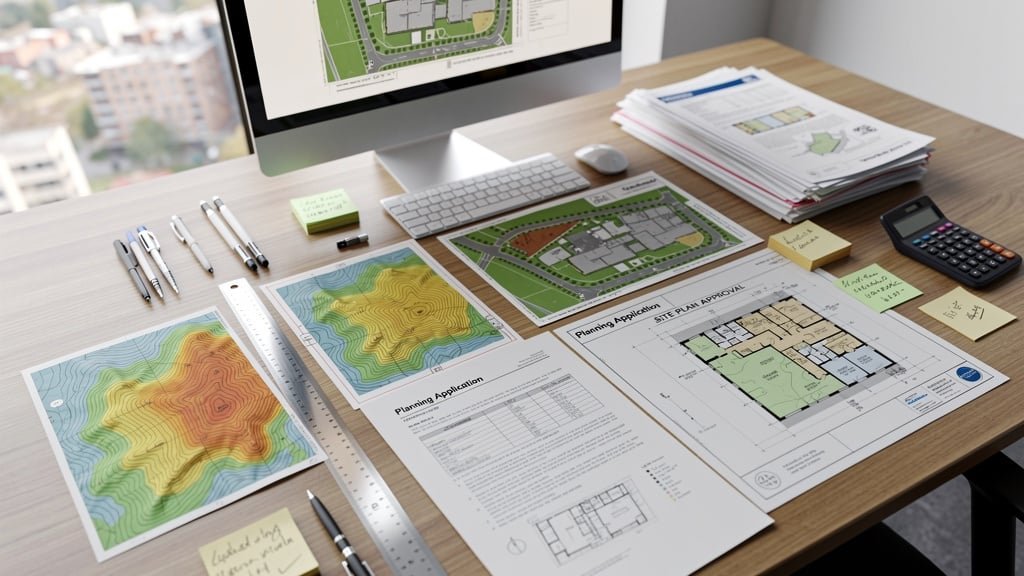
Navigating the UK planning system can feel like traversing a maze, especially when you're unsure what documentation local authorities actually need. Topo Surveyor has supported thousands of planning applications across the UK, and we've learned that having the right survey data from the start dramatically increases approval chances while reducing delays and costly resubmissions.
This comprehensive guide explains exactly which surveys planning applications require, what information they must contain, and how professional land surveying services help you navigate the planning process successfully. Whether you're planning a home extension, commercial development, or new build project, understanding survey requirements saves time, money, and frustration.
Why Planning Applications Need Surveys
Planning officers face a challenging task. They must assess whether proposed developments are appropriate for their locations, comply with local plans, respect neighboring properties, and address environmental concerns. Without accurate survey data showing existing site conditions, making these assessments becomes guesswork rather than informed decision-making.
A topographical survey provides the objective, measurable information that planning officers need. The survey report shows exactly what exists on site currently—terrain levels, existing structures, boundary positions, drainage patterns, vegetation, and all features that might affect development feasibility. When architects design proposals using accurate survey data, their plans demonstrate realistic understanding of site constraints and opportunities.
Planning authorities across the UK have increasingly standardized their requirements, but significant regional variation still exists. What Manchester City Council considers adequate might differ from what Westminster or Edinburgh require. However, certain survey types appear consistently in planning application guidance across most local authorities.
The Topographical Survey for Planning
The topographical land survey forms the foundation of most planning applications. This survey type captures comprehensive three-dimensional information about your site, providing the base data that architects use to create site plans, sections, and elevations showing how proposals relate to existing conditions.
When carrying out topographical surveys for planning applications, our land surveyor team focuses on elements that planning officers specifically assess. The survey data must show contour lines at appropriate intervals—typically 0.5 to 1 meter for residential sites, potentially finer for complex terrain. These contours reveal how land slopes, where water naturally flows, and whether proposed buildings will require significant earthworks.
Boundary information features prominently in planning surveys. Officers need to see that proposals respect property lines and maintain required setbacks from boundaries. Our survey reports include measured boundary positions referenced to title documents and physical features, helping demonstrate that developments stay within applicant-owned land and comply with planning policies about building lines and boundary treatments.
Existing structures require accurate documentation. The topographical survey shows all buildings, outbuildings, walls, fences, and permanent features with precise dimensions and heights. This information helps planning officers understand the existing built form and assess whether proposals represent appropriate additions or changes. For conservation areas or listed buildings, this existing context becomes even more critical to planning decisions.
Drainage and water features carry significant weight in planning assessments. The survey identifies manholes, gullies, ditches, streams, and surface water flow patterns. With increasing concern about flooding and drainage capacity, planning officers want confidence that developments won't create or worsen water management problems. A detailed topographic survey showing existing drainage helps demonstrate that proposals address water appropriately.
Vegetation mapping matters more than many applicants realize. Trees visible from public areas, mature specimens, or trees covered by Tree Preservation Orders require careful consideration in planning decisions. The topographical survey records tree positions and approximate sizes, though for sites with significant trees, authorities typically require a dedicated tree survey providing greater detail.
Access routes and sight lines require documentation in most planning applications. The survey shows vehicle and pedestrian access points, road widths, parking areas, and features affecting visibility splays at junctions. Highways authorities review these aspects carefully, and having accurate survey data prevents delays when they request additional information about access arrangements.
Underground utility surveys complement topographical data when proposals involve significant groundworks or new utility connections. Knowing where services run prevents design conflicts and demonstrates that developments can connect to necessary infrastructure. Some planning authorities require utility information as standard, while others request it only for larger developments.
Specific Survey Requirements by Development Type
Different development types trigger different survey requirements. Understanding what your specific project needs helps you commission appropriate surveys from the start.
For residential extensions and alterations, planning applications typically require a topographical survey showing the existing house, garden, boundaries, and immediate surroundings. The survey should extend several meters beyond the property to show neighboring properties and demonstrate how the extension relates to the area's character. Measured building surveys of the existing house help architects create accurate existing and proposed drawings. If the extension affects trees or requires drainage modifications, tree surveys or drainage assessments may become necessary.
New build residential developments demand comprehensive topographical land surveys covering the entire site plus adjacent areas affecting access and context. The survey must show detailed contours, all existing features, boundaries, utilities, trees, and drainage. For larger sites, planning authorities often require phase one habitat surveys identifying ecological features, and detailed tree surveys following BS5837 standards. Ground conditions surveys or contamination assessments might be needed depending on previous land use.
Commercial and industrial developments face rigorous survey requirements. Beyond comprehensive topographical surveys, authorities typically require transport assessments involving detailed access surveys, visibility splay measurements, and traffic impact studies. Noise surveys, air quality assessments, and ecological surveys frequently appear in pre-application advice for commercial projects. The survey package must demonstrate how developments address all material planning considerations, from highways safety to environmental protection.
Change of use applications vary widely in survey requirements depending on the proposed use and local policies. Converting a barn to residential use might need detailed measured building surveys documenting the existing structure, topographical surveys of surroundings, ecology surveys checking for protected species, and heritage statements if the building has historic significance. Planning authorities want evidence that the building can accommodate the proposed use without inappropriate alterations.
Agricultural buildings and structures often benefit from simplified planning procedures, but they still require basic topographical surveys showing site context, access arrangements, and any sensitive features. The survey helps demonstrate that agricultural buildings are appropriately located and sized for their intended purpose.
Survey Accuracy and Standards for Planning
Planning applications require surveys meeting professional standards. Planning officers have seen countless applications with inadequate or inaccurate survey information, and they've learned to scrutinize survey quality carefully. Using professional land surveying services from accredited surveyors provides confidence that your survey data meets required standards.
Accuracy standards depend on development scale and complexity. For residential extensions, surveys accurate to 50-100mm generally suffice. Larger developments or sites with critical level requirements need higher accuracy, potentially 10-20mm for key features. Our land surveyor team uses highly specialised survey equipment including total station instruments and GPS technology to achieve appropriate accuracy for each project type.
Survey drawings must be clearly presented at suitable scales. Planning officers prefer CAD drawings they can measure accurately rather than sketches or photographs. Common scales include 1:200 for house plots, 1:500 for larger residential sites, and 1:1250 for major developments. The survey report should include scale bars, north points, legends explaining symbols, and coordinate information referencing Ordnance Survey grids.
Dating matters more than applicants sometimes realize. Planning authorities want survey data reflecting current site conditions, not historical situations. Surveys older than 12 months may be rejected if significant changes have occurred. Seasonal variations also affect survey information—a summer survey might not show drainage issues apparent in winter, or trees in leaf obscure ground features visible when dormant.
Professional certification gives planning officers confidence in survey quality. Our survey reports clearly identify the surveyor responsible, state the survey date and methods used, specify achieved accuracy, and note any limitations. This transparency helps planning officers assess whether the survey provides adequate information for decision-making.
Integrating Surveys with Planning Applications
Having excellent survey data only helps if it integrates properly with your planning application. The survey report provides raw information, but architects and designers must interpret and present it appropriately for planning purposes.
Architects use topographical survey data to create location plans showing the site in its broader context, typically at 1:1250 or 1:2500 scale. These plans show the red line boundary defining the application site and blue lines indicating other land under the applicant's control. The survey data ensures boundary lines accurately represent site extents rather than approximate sketches that might misrepresent ownership.
Site plans at larger scales, usually 1:200 or 1:500, show detailed proposals overlaid on existing conditions from the topographical survey. Planning officers scrutinize these drawings closely, checking that proposals respect boundaries, maintain adequate access, provide appropriate parking, address drainage, and relate sensitively to existing features. When site plans accurately represent existing conditions from professional surveys, proposals appear credible and well-considered.
Section drawings demonstrate how proposals relate to existing ground levels and neighboring properties. These drawings rely on contour data from topographical surveys to show existing terrain profiles accurately. Officers use sections to assess whether developments appear overbearing, whether floor levels work appropriately, and whether proposals properly address level changes across sites.
Tree protection plans for sites with significant trees build directly on tree surveys. These specialized drawings show trees to be retained, their root protection areas, and protective fencing locations. Planning conditions frequently require developments to follow approved tree protection plans, so accurate survey data underpinning these plans helps ensure compliance during construction.
Drainage strategies increasingly form essential parts of planning applications. Topographic surveys showing existing drainage features and flow patterns help engineers design appropriate drainage systems addressing surface water, foul drainage, and flood risk. Planning authorities want confidence that developments won't worsen flooding or overload existing drainage infrastructure.
Common Planning Application Survey Mistakes
Experience reviewing planning applications has shown us recurring survey-related problems that delay approvals or cause rejections. Avoiding these mistakes keeps applications moving forward smoothly.
Inadequate survey extent causes frequent problems. Applicants sometimes commission surveys covering only their property without including surrounding context. Planning officers need to see how proposals relate to neighboring properties, street scenes, and local character. A survey extending 5-10 meters beyond the property boundary usually provides necessary context for most residential applications.
Missing features create questions that delay decisions. If the survey fails to show overhead cables, underground services, or boundary treatments, planning officers request additional information before determining applications. Comprehensive topographical surveys capturing all relevant features prevent these delays.
Inaccurate boundary positions cause serious problems. Proposals shown encroaching into neighbors' land raise concerns about whether developments are actually achievable. Professional boundary surveys providing accurate property line positions help avoid these issues and potential disputes when developments proceed.
Outdated survey information misleads planning assessments. Sites change over time—trees grow, structures are built or demolished, drainage alters. Using recent survey data ensures planning decisions are based on current reality rather than historical conditions that no longer exist.
Insufficient detail frustrates planning officers. Surveys showing vague outlines rather than precise measurements, approximate levels rather than accurate contours, or incomplete feature mapping force officers to request clarification. Detailed surveys meeting professional standards avoid these delays.
Poorly presented survey drawings reduce clarity. Cluttered plans with unclear symbols, missing legends, inappropriate scales, or inconsistent conventions make interpretation difficult. Professional CAD drawings following standard conventions communicate information clearly to planning officers.
Pre-Application Advice and Survey Requirements
Most local authorities offer pre-application advice services where planning officers provide guidance before formal applications are submitted. These consultations represent valuable opportunities to clarify exactly what survey information authorities need for your specific site and proposal.
Taking survey data to pre-application meetings helps discussions become concrete rather than theoretical. When officers see actual site conditions documented professionally, they can provide specific advice about constraints, opportunities, and information requirements. We often recommend clients commission basic topographical surveys before pre-application meetings, then add specialized surveys based on officers' feedback.
Pre-application advice frequently identifies survey requirements that weren't immediately obvious. Officers might highlight ecological sensitivities requiring habitat surveys, mention tree preservation concerns necessitating detailed tree surveys, or note flooding history requiring comprehensive drainage assessments. Getting this guidance early prevents commissioning inadequate surveys that must be supplemented later.
Some authorities maintain formal validation checklists specifying exactly what information applications must include before being accepted. These checklists typically include survey requirements specific to development types and local circumstances. Reviewing validation checklists before commissioning surveys ensures you obtain appropriate information from the start.
Cost Considerations and Planning Timelines
Survey costs represent small fractions of overall development costs, but getting correct information early can save considerable time and reduce costs throughout the planning process. A comprehensive topographical survey for a typical residential plot costs £600-£1,200 depending on size and complexity. Specialized surveys like detailed tree assessments, habitat surveys, or drainage studies add to this baseline.
These survey costs should be weighed against the value they provide. Planning applications without adequate survey data face delays while additional information is gathered. Each delay cycle typically adds 4-6 weeks to determination times. For commercial developments where time has significant financial value, survey costs become trivial compared to delay costs.
Refusal based on inadequate information wastes application fees and requires resubmission with associated delays and costs. Starting with comprehensive survey data meeting authority requirements avoids these expensive setbacks.
Survey timelines affect application scheduling. Most topographical surveys are completed within 1-2 weeks from instruction to report delivery. Specialized surveys might take longer—tree surveys best done during growing seasons, ecology surveys have seasonal constraints, ground investigations need several weeks. Planning these survey timelines ensures survey data is available when architects finalize application drawings.
Working with Professional Surveyors
Choosing the right survey company affects planning application success. Not all surveyors understand planning requirements equally well. Our land surveyors have extensive experience supporting planning applications and understand what authorities need to see.
When you get in touch with Topo Surveyor about planning application surveys, we discuss your project type, planning authority, and specific requirements. This consultation helps us recommend appropriate survey scopes ensuring you obtain necessary information without commissioning unnecessary work. We can review pre-application advice if you've received it, or suggest speaking with planning officers if requirements remain unclear.
Our survey reports include explanatory notes highlighting features particularly relevant to planning considerations—sight lines, level differences, drainage patterns, or other site characteristics affecting development proposals. This planning focus helps architects and planning officers quickly identify critical information.
We maintain dialogue throughout the planning process. If planning officers request additional survey information or clarification, we respond promptly to keep applications progressing. Sometimes officers want specific features measured or particular areas surveyed in more detail—we can often provide this supplementary information quickly from existing survey data or brief site revisits.
Conclusion: Survey Foundations for Planning Success
UK planning applications succeed or fail based on the quality of information supporting them. Professional land surveys provide the objective, accurate data that planning authorities need to assess proposals confidently. Whether you're planning a home extension or major development, investing in appropriate surveys from the start increases approval chances, reduces delays, and demonstrates professional, well-considered proposals.
At Topo Surveyor, we've supported planning applications ranging from small domestic extensions to major commercial developments. Our understanding of planning requirements helps ensure the survey data we provide meets authority expectations and gives your application the best possible foundation for approval.
If you're preparing a planning application and need survey support, get in touch with our survey experts. We'll discuss your project, clarify survey requirements, and provide professional land surveying services that help your planning application succeed.
Planning Application Survey Support
Our experienced surveyors provide comprehensive topographical surveys, tree surveys, and specialist assessments for planning applications across the UK. We understand what authorities need and deliver survey data that supports successful applications.
Planning a Development Project?
Ensure your planning application succeeds with comprehensive survey services from our expert team. We provide all the surveys local authorities require, delivered on time and to specification.
Discover our complete range of survey services for planning applications →